I have learn many things in my entire journey of EC&I 833. It has been a wonderful experience for me and I came to know many new terms and concepts that has helped me to enhance my knowledge.
I would like to thanks Dr. Katia and my fellow students for their support and guidance in this entire journey.
I have attached my reflection audio in this blog, kindly acknowledge this and leave your feedback.
Assessment should be like the conversation which includes engagement and interactions. Whereas, in functionality the assessments are mainly concerned with grades and the numbers rather than the conversation. There are different technological tools that can help to make assessment more interesting and engaging like a conversation.
Here are some ways that will help us to have a conversational assessment approach:
Feedback tools: These are the tools that helps the facilitator to provide the feedback in audio or video form to make the assessment more engaging. It makes the assessment to feel like a dialogue.
Peer review: Different online platforms can be used for peer reviews and it motivates the students to analyze and evaluate each other’s work. This will also help them to have a good conversation with each other and enhance the engagement level of students in the classroom.
Adaptive learning systems: As per this system the difficulty level and nature of the assessment should be adjusted as per the progress of the learner.
E-portfolios: This help the students to gather their work in chronological order and summarize their learning journey and give a broad reflection of their progress and development in the entire journey.
So these are the different ways that we can use to make the assessment process more interactive and engaging.
By integrating coding in the classroom an educator can enhance the creativity, thinking power and learning abilities of the students. Learning coding in the schools help the students to shape their future in a better way.
Value of Coding for Students:
Coding help the students to face different challenges by breaking them into small parts and then solve them as a result it enhance their problem solving skills and make them more creative. With the help of coding students can innovate their own games, apps and animated creatures and can bring their thoughts into reality and get a source through which their imagination can turn into functionality. They become the creator of technology rather then just users. It also help them to prepare for their future careers in different areas such as health, education and finance.
Do all students benefit?
Although coding provides equal access and benefits but all students are not equally engaged with it. Students who belongs to the underprivileged areas are not having the adequate resources as a result they lack behind. As all the learners have different way of learning so, many learners are not able to adapt the learning style of coding activities.
Should only Techies teach coding?
I think that not only techies but educators can also teach coding in the schools. There are many platforms which help the educators to learn coding as well as to teach the same in the classroom side by side. It is a technique which facilitates the problem solving skills so the technical mastery is not the necessity. There are different resources available for the educators such as tutorials, coding camps which help the educators to boost their confidence of teaching coding.
As an early childhood educator AI is playing a vital role in my day to day life as it helps to increase my efficiency, creativity in my personal life as well as in my professional life. Here i am sharing my perspective on the use of AI and its future potential.
AI helps me a lot to plan my day as an early childhood educator. I can get a variety of ideas to plan the different engaging activities for my kids. Different activities can be planned for different age groups by using AI tools. AI also helps me to create age appropriate content and stories for my kids where I can customized the characters and content of the stories as per my requirement. AI tools also saves a lot of time by helping in drafting mails, newsletter and different documents required in our daily routine of work. AI also acts as a mentor for me as it helps me to solve different classroom problems by providing the deep information about child psychology and different ways of engaging students in the classroom.
As i talk about my personal life, so in that case also AI is helping me a lot. I love to do paintings and other creative things and for that i get plenty of ideas through AI which helps me to improve my skills. It inspires me to look at the new ways of doing the things and help me a lot in my personal growth. The major drawbacks of using AI is that sometimes the information provided by it is not correct so we have to be careful before using it, it also reduce our thinking and creativity power as we are depending on AI for all the ideas and the issue of data privacy is also there.
I can imagine the future of AI as our collaborative partner who will help us to enhance our capabilities and offer the personalized learning experiences to make the learning process simple and accessible for all individuals.
Our journey about Educational Technology EC&I 833 have been a transformative experience from enhancing our understanding about EDTech to exploring new approaches of integrating digital tools in the classroom. We understand how Educational Technology has evolved from chalkboards to AI and coding and how this advancement has prioritized societal needs. As Tony Bates said Technology has reached rural areas where schools can’t reach. However, we would agree with the Neil Postman perspective about how technology comes with trade offs like Google workplace encourages collaboration but it raises a crucial concern about equity and privacy. Additionally, we discussed the important learning theories like behaviorism, collaboration and constructivism that guides us to integrate various tools like Kahoot, google docs to foster active learning and engagement among students. Through this course, evolution from Web 1.0 to Web 3.0 was an impact topic to realize the drastic transition and experiencing AI driven learning. This transition has inspired us to think critically about how we can integrate useful tools to experience personalized learning in our classroom while considering diverse needs of our students. The topic Assistive technologies have highlighted the concept of inclusivity and how we can take care of diverse needs in our classroom. We invite you all to watch our summary of Learning video as it reflects our journey of personal experiences, insights and vision about Educational Technology.
Wow! As the saying goes, learning is a lifelong journey. My experience in this course (Foundations of Educational Technology: History, Theory, and Practice) has been truly enlightening. Despite using technology in my teaching practice and instructing others on its implementation in science education, I hadn’t delved into the philosophical underpinnings and the complexities of commercialization and commodification in the realm of digital technologies. To ensure a safe journey, the pilot (Prof Katia) instructed the class to conduct a security check. This involved examining my understanding of educational technology, which I viewed as the ethical application of technological resources and processes to improve teaching, learning, and performance. Then certain guidelines and roadmaps tagged theories of knowledge and learning were explored. These roadmaps actually laid a foundation for how to plan and establish strategies that align with my student’s needs when teaching or trying to use technology in the classroom.
Roadmap for navigating the use of technology
Then the journey began as we navigated various milestones (technology tools) used to impact learning in the classroom. Those weeks of exploration were a playground of ideas and reflection for me. I learnt a lot from all the great presentations, and they really enhanced my understanding of how technology can be effectively implemented in classrooms. However, some concepts, such as assistive technologies, particularly resonated with me as they challenged my preconceived notions. I had always associated assistive technologies with individuals with disabilities, but the presentation changed my assumption. Moreover, drawing on the discussion on assistive technologies, I realized that I have used screen readers and adaptive quizzes in my personal practice. Talking about the AI in education presentation, I think that was also amazing.
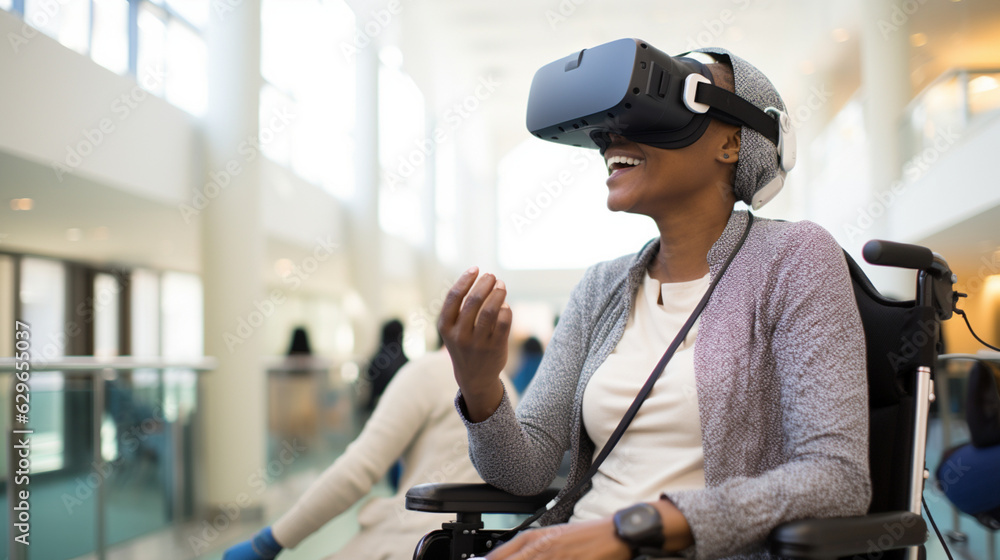
A Man in a Wheelchair Using a Virtual Reality Headset
The presenters shared some useful platforms that I have begun exploring, and that’s another great hit in my learning experience. I also gained insights into strategic ways to engage K-12 students with generative AI. While I think the coding and makerspace presentation was intriguing, unfortunately the presenters were unable to fully engage the class in further discussions due to time constraints. Reflecting on my learning journal, where I explored various learning philosophies such as constructivism, pragmatism, and connectivism, I considered how these philosophies could be enhanced with digital tools like Padlet, social media platforms, Zoom, Arduino, ChatGPT, and Kahoot. A key question I ask myself is, “Which philosophy best aligns with my teaching practices and technology use in the classroom?”
Below is my summary of learning.
I am grateful for the opportunity to learn alongside such wonderful colleagues. Thank you all for sharing your knowledge, time, insights, and personal experiences. I would also like to express my gratitude to Professor Katia for teaching this course and providing us with a platform to share our ideas. Here’s to a successful 2025!
Hi everyone! Below is my summary of learning. You should be able to first click on the house icon, and then each of the titles in the numbered sections. Also, if you click the plus signs, there will be little interactive questions. Some of the interactive questions where it is an opinion answer, I chose... Continue Reading →
Nowadays, Generative AI has integrated into our lives in such a way that we can’t even think of living without technology for a second. My journey of teaching has been reshaped through generative AI. As a teacher, I have witnessed how AI has the potential to transform the educational experience and provide a better learning environment especially for those who belong to remote areas.
Impact of AI on my Teaching Journey
Drawing from my experiences, As a teacher, the major challenge was adapting your pedagogy according to the diverse learning styles of students due to limited resources. However, Generative AI has been the game changer in providing a personalized learning environment in the classroom. With the support of AI tools like chatGPT, canva, Khan academy or Kahoot I have provided my students an interactive classroom environment where they can explore unique ways of teaching and learning. They can learn through games on Quizzes app or they can have customized practice problems or visual explanations to the content. Generative AI has played a crucial role for students in rural areas, where the access to the resources or quality education is often limited. AI tools have given opportunities to students to explore topics like coding or STEM and the future of coding in the ed-tech industry has drastically risen in the world. While working as an Educator, I have integrated Cognitive Coaching techniques in my teaching style to understand my students’ emotional and social needs. Generative AI tools have supported me in achieving this success for my students.
Role of Generative AI in My Personal Life
Beyond teaching, Generative AI has been beneficial in my personal life. From cooking my favorite dishes to organizing my day, AI has been very supportive in making my everyday activities effective. Various AI Apps like Fitbit have been very helpful in tracking my health progress and are a major part in achieving wellness goals. AI boosts our personal lives by saving precious time, promoting fitness and fosters creativity. However, every coin has two sides, Thus leveraging Generative AI fully is a huge challenge. There are certain reasons like sometimes uneven internet connectivity, lack of digital tools or limited professional teachers which comes as hurdles in a path to be successful. However, I believe AI has the power to bridge the gaps of urban rural educational division or provide equal opportunities of quality education to underprivileged students.
The Future of AI in Education
I believe the future of Generative AI is to revolutionize the education system by making it more accessible and engaging. Even the students from remote areas would have equal access to learn using AI tools. AI should be considered as a tool for creating opportunities for excellent growth and better learning.AI would be beneficial not only for students but for teachers also in reducing their administrative work so that their focus should only be on fostering creativity and better learning environment in the classrooms. Through Generative AI, I aim to encourage my students to achieve goals, think big and embrace change for their future.
At work (as a teacher), I have used AI a few different ways. I have asked AI for ideas on lessons. I find that it takes some practice prompting AI to get lessons/activities that will work for my class but I have gotten some good ideas. I have also asked AI to help me reword... Continue Reading →
Learning how to code can have multiple benefits for students. It helps them build creativity, perseverance, and problem solving skills. It also helps kids understand the technology that is around them. Coding is also a career building skill. As society becomes more and more entrenched in technology, the need for coding skills will become more... Continue Reading →




 The Future of AI in Education