Theories of learning

As an educator various theories of learning has influenced my teaching journey but the one that underpin my classroom practices is constructivism theory. In the initial stage of my teaching, constructivism theory given by Jean Piaget and Lev Vygotsky has a major impact on my teaching practices. This theory states that the interest of the learners is built through their active engagement in the classroom activities and practices using new material and ideas. It focus on student centered learning, where students construct their knowledge through experiences rather than simply receiving the information from the teacher. In this theory the main task is to create a classroom environment where students find their answers on their own and discover new things and ideas through various activities and group practices.

As I have gained more experience in teaching field and observed more things, I have recognized the importance of social learning in education field. Gradually, I have started integrating Albert Bandura’s Social learning theory in my classroom practices. As per his theory learning takes place within social context, specifically through imitation, modelling and observation. Students learn more while interacting with their peers, teachers and with other people in their surroundings. After observing these things, I have started incorporating collaborative learning practices in my classroom teaching. I have planned the group activities where they observe that how their friends are performing the activities and imitate their actions and was able to perform activities more effectively and efficiently. During these activities they are also learning social etiquettes, as how to deal with peers and friends in the social structure. By incorporating the elements from various theories, I was able to develop a more flexible and student centered approach that helped me to make the teaching learning process more effective. But, I believe that as I go forward in this field my beliefs will continue to shift both as a learner and as an educator as per the changes that takes place in education sector.

Theories of Knowledge

This week in class we discussed theories of knowledge. We talked mainly about Behaviourism, Cognitivism, and Constructivism. Behaviourist theories are concerned with how people respond to stimuli instead of study of the mind. People can be conditioned to have a certain response to a stimulus where the response and stimulus have no obvious connection (think... Continue Reading →

Reflection on my Teaching Philosophy

    MY TEACHING PHILOSOPHY 

My teaching philosophy has been reshaped over time by numerous experiences as a teacher, diverse theories of knowledge and learning. There are multiple theories and philosophies that support my teaching practice, and they have played a significant role in helping me become a better teacher. These frameworks have led the way to my growth and I have shifted my objective from a more conventional, subject-based teaching approach to a more holistic, student-centered approach, where I see learning as a dynamic, interactive, and reflective process. The merging of technology, cognitive coaching methods, and social-emotional learning has enriched my teaching philosophy, enabling me to focus not just on academic success but also on the personal growth and well-being of my students.

Reflecting on my teaching journey, the constructivist theory by Piaget has really helped me create an environment for the learners to explore, question, and build their understanding. I see myself as a facilitator who provides opportunities to students to engage and participate in exploration, problem-solving, and critical thinking rather than simply giving lectures. Here I would like to share my experience when I adopted constructivist approach by replacing traditional lecture method, When I was teaching class 8, a lesson on water cycle, like instead of simply drawing the cycle on the board and asking them to learn instead, I guided them through an experiment to simulate evaporation and condensation. After That, giving them a chance to create their own models of water cycle. This hands-on method allows them to construct their own understanding of the topic, leading to deeper engagement and long retention. This constructivist approach broke away from traditional methods and empowered students to actively participate in their own learning process.


As an early childhood educator working in Canada, I see the significant importance of social-emotional learning, particularly through Maslow’s hierarchy of needs. At the start of the day in daycare, I have learned the value of “reflection circles”, where all the students can express how they are feeling. This practice encourages students to share their emotions and allows me to check in on their emotional well-being, especially in classrooms with high-stakes pressure. 


Key references:

https://youtu.be/k_oYU2YKMe4?si=RNWmhYYxPFc09fCD

https://opentextbc.ca/teachinginadigitalage/part/chapter-2-the-nature-of-knowledge-and-the-implications-for-teaching/


Theory of knowledge: How has it been helpful?

Based on this week’s discussion on theories of knowledge and reading “The Nature of Knowledge and the Implications for Teaching by Bates and Bates (2019), I had to do a quick reflection on my secondary school experience as a science student. I recall having a teacher (Mr. A), whose teaching approach made me dislike physics as a subject. Mr A was always objective about his teaching and presented physics as a body of knowledge consisting of facts, formulas, terminology, principles, and theories to be learned. As a result, physics was very boring to me in grade 10 because Mr A would only read out notes without engaging students in hands-on practical, unlike our chemistry teacher. However, in grade 11, a new and fantastic teacher (Mr B) arrived. He engaged us in practical experiments and project activities related to the concepts we learned in class. He often demonstrated activities, encouraged us to make observations and predictions, and then facilitated further discussions or notes on the concepts. We even went on school trips to see how what we learned in class applied to the real world and visited communities to understand how science is embedded in indigenous practices.  Mr B’s teaching style which is aligned with the constructivit approach transformed my perception of physics and inspired me to study physics education at the university. Just like some students, I have always had the misconception that…………
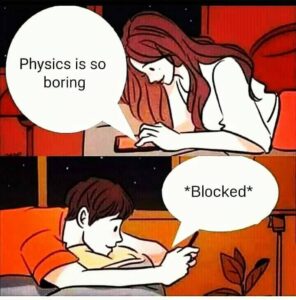
r/meme from reddit.com

based on the experience with Mr. A, who had always been objective in his teaching and sometimes transmissive in his lesson presentation. However, my experience with Mr. B changed this belief and became the inspiration for my own approach as a teacher.

So, if I am to relate Mr B’s approach to this week’s class discussion, I could see elements of constructivism theory in his teaching style, which has also been the foundation of my teaching philosophy.
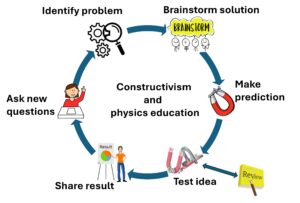
Mr. B’s approach can be likened to the constructivist theory that posits “learning as an essential social process, requiring communication between learner, teacher, and others” (Bates & Bates, 2019). The theory focuses on students’ active engagement in learning, where teachers build students understanding through thoughtful reflection and analysis. I believe in this Chinese proverb from the Froebel Journal (1967) that says, “What I hear, I forget; what I see, I remember; and what I do, I understand. My interpretation of this expression is that children already have some foundational knowledge of whatever they are being taught based on their surroundings, however, they tend to learn better when they are actively engaged in the teaching process, using experiences from their immediate surroundings to explore concepts taught in the classroom (i.e., learn by doing). However, over the course of my teaching career, I have realised that children are unique in their individual being and tend to learn differently. Hence, the type of approach I use in my class will depend on the topic explored. Nevertheless, I see that the “asking question” component of inquiry learning, which is aligned with the constructivist approach, is a fundamental component of my practice, and it can be adapted to any teaching style.

In the medium article on Skinner’s teaching machine by Abhishek Solanki (2019), the author indicated that the teaching machine is based on Skinner’s belief that “changes in human behavior are a response to external events that occur in the environment”. According to Abishek, Skinner’s teaching machine operated on the principles of operant conditioning (using reward and punishment to modify the development of behaviors) and programmed learning (allowing students to learn step-by-step, ensuring they grasp each concept before moving on to the next), designed to enhance the educational experience by providing individualized instruction (adaptive learning). As a school teacher and a teacher educator, assessment also plays an important role in determining my students learning. I have always found myself using multiple choice questions and fill-in-the blank questions to explore students understanding of what was taught and using their responses to provide feedback.  But, I sometimes feel this does not test the true understanding of students because it is either true or false, right or wrong. These methods do not assess in-depth knowledge and application of concepts taught. However, I have also tried incorporating problem-solving tasks that challenge students thinking and ability to apply concepts taught in practical activities. These activities sometimes require students to research ideas and do presentation in class or sometimes perform experiments in group with little guidance.  I think this approach mirrors the constructivist theory.

History and Foundation of Education Technology

In present scenario the definition of the term ‘educational technology’ has evolved to a large extent which includes the integration of different methodologies, digital tools and philosophies. A contemporary definition of education technology can be refer to as a holistic framework that integrates the digital tools to facilitate learning and will help to improve the educational outcomes.

digital education: online courses and apps for adult learners

I have read  the article A short history of educational technology, and it was very interesting to see the changes that took place in the field of education from teaching through blackboards and books to using digital tools and innovations for teaching in modern era. The article focus on the role of radio and television in distance education and then highlights the impact of computer assisted learning and internet in teaching. the motive of the article  is to explain how advancement in technology has reshaped the practices in education.

Lifelong learning concept. Man holding and reading the book.

My understanding and practice of using educational technology has evolved in multiple ways. When I was a student my teachers were using books and blackboards to teach us and gradually these blackboards were transformed into smart boards and the studies became more interesting for us because of these smart boards. Then slowly and gradually the use of computers and technology has increased in the field of education for different purposes. As I became a teacher I can see a drastic change in the field of education because of these digital tools as they have opened the way for deep learning and connections. Technology advancement in education has made the learning process more flexible, interactive and adaptive for the students as well as the teacher. As per my view point educational technology is something more then a tool as it is accessible to everyone and it allows life long learning for all the individual which was not possible earlier.


Education+technology= educational technology?

How can we define educational technology? Well, two words. One being educational and the other technology. Merriam-webster defines "educational" as: "the field of study that deals mainly with methods of teaching and learning in schools" and "technology" as: "the practical application of knowledge especially in a particular area." So, if we were to put those two... Continue Reading →

My Perspective on Educational Technology

Educational Technology

Image generated by AI

As an educator, I am required to plan my lessons before going to the classroom. Lesson planning requires the use of various instructional resources that can help guide the selection of appropriate content, tasks, teaching strategies, and feedback mechanisms that teachers can use to enhance learners’ understanding. These instructional resources can include the use of print and non-print materials as well as technology resources.  As an experienced classroom teacher and a science education lecturer, I have had the opportunity to use various hardware, like projectors and laptops, and software, like the Unity app, simulations, and ed apps, in my class. These hardware and software resources encompass a subset of what is called ‘educational technology.”

Reflecting back to how technology was used in my primary and secondary school days, educational technology was more about the use of audio aids (recordings), visual aids (VHS videos) and audiovisual aids (television programs), particularly during special events at schools or in the home. Unfortunately, these technologies did not promote active learning because they were more centred on the presenters (teachers) and the material itself. However, the emergence of modern technologies has provided more opportunity for enhancing the learning and communication process, thereby promoting students active engagement and encouraging personalized learning.

In a simple term, educational technology can refer to the tools, technologies, and resources that can enhance learning experiences. This includes hardware like computers and software like simulations and LMS, as well as emerging technologies like AR and VR (Huang et al., 2019). It’s grounded in educational theories on behavior, cognition, processes, and knowledge construction that are applied in technology development (Ouyang & Stanley, 2014).


References

  1. Huang, R., Spector, J. M., & Yang, J. (2019). Educational Technology: A Primer for the 21st. Springer: USA, https://doi.org/10.1007/978-981-13-6643-7_1
  2. Ouyang, J. R., & Stanley, N. (2014). Theories and research in educational technology and distance learning instruction through Blackboard. Universal Journal of Educational Research2(2), 161-172. https://eric.ed.gov/?id=EJ1053980