This week, my classmates did a presentation on Web 1.0 and Web 2.0 which represent the evolution of internet or two distinct stages of the World Wide Web’s development. To be frank, I hardly had any idea about the given terms unless I discovered from the presentation that Web 1.0 allowed us to access information whereas Web 2.0 made it possible for us to interact, communicate and connect with each other. The presentation paved way for me to reflect on how Web 2.0 or the “social web” is reshaping our world through positive and negative influences to our lives and society.
“The Social Dilemma” a documentary film on Netflix reveals how Web 2.0 has led to making meaningful connections and knowledge-sharing although it brings along challenges concerning social media.The article The internet: Can it really influence social movements? shows how Web 2.0 has enabled social movements like political advocacy, environmental campaigns, raising awareness on issues of inequality etc to gain pace by giving a voice to those who may not have been heard otherwise. Social media platforms like Twitter, Facebook and Instagram allows users to raise their voices for causes they care about, even from across the globe. This underscores the role of social media in enhancing civic engagement through its capacity to mobilize quickly and reach a wide population fostering social change.
However, the dark side of Social media platforms is also portrayed perfectly in the “The Social Dilemma” revealing the fact that they operate on business models designed to maximise user engagement, growth and advertising revenue. The documentary discusses how companies track and analyse every click, scroll and share leveraging AI algorithms to keep users engrossed. The ill effect of this is on young people who experience increased mental health challenges, anxiety and depression. The characters Ben and Isla in the show are negatively affected by social media addiction and unrealistic beauty standards and illustrates how these addictive algorithms can lead to social isolation, manipulation by misinformation and even radicalization.
Decoding the impact of these issues on schools and young learners reveal that Web 2.0 ‘s interactivity and social features allow students to collaborate, learn and share information through platforms like Google Classroom. Such platforms provide a digital space where students can work together, and teachers can facilitate interactive learning experiences. However, it is to be noted that misinformation and “fake news” through social media further complicate the educational landscape advocating schools to emphasize digital literacy and critical thinking skills to help students navigate online content responsibly.
Finally, reflecting on the influence of Web 2.0,I believe that while it has made learning more accessible, engaging and relevant it brings alongside responsibilities for educators and institutions to educate students in wise and responsible usage of these tools.Down the line we must design strategies to maximise the benefits of Web 2.0 while mitigating its negative impacts to create a balanced digital landscape for future generations.
The evolution and development of the web, more commonly known as the internet nowadays, has grown by leaps and bounds throughout the decades. The internet has grown exponentially from Web 1.0 to Web 3.0.
Web 1.0
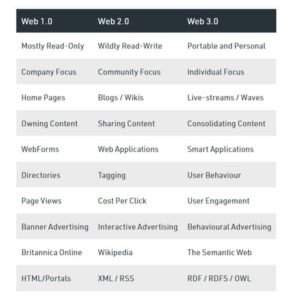
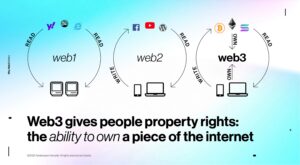
Web 1.0 is the term for the earliest version of the internet from the 1990s to the early 2000s (Ledger Academy, 2023). It was referred to as read-only web or static web, with very limited interactivity and simple website designs. Interaction with websites during this era was very basic. Users could click on links to navigate between pages, but features such as online shopping, social networking, and user-generated content were virtually non-existent. In addition, websites were designed with minimal multimedia elements — barely any pictures or videos.
Web 2.0
Web 2.0, on the other hand, is an evolution of Web 1.0. Web 2.0 is considered as dynamic web, as opposed to Web 1.0, which was normally text-based. Also, Web 2.0 is what is commonly known as internet wherein social media is commonly used; social media sites such as Facebook, Instagram, and X (formerly known as Twitter), to name a few, are used to communicate and interact. According to Kenton (2024), Web 2.0 has more user-generated content, greater usability for end-users, and a more participatory culture within the internet users. Users of the internet can publish articles via blogs and even upload vlogs (video blogs) on video-sharing sites such as YouTube, thus expanding their reach.
With Web 3.0, the data generated by disparate and increasingly powerful computing resources, including mobile phones, desktops, home appliances, and vehicles, will be sold by users through decentralized data networks, ensuring that users retain ownership control. Users will therefore have more “control” over the internet. Additionally, in Web 3.0, it will use machine learning, a branch of artificial intelligence or AI that uses data and algorithms to imitate how humans learn, thus improving its accuracy.
Gerstein on the Evolution of the Web and Education
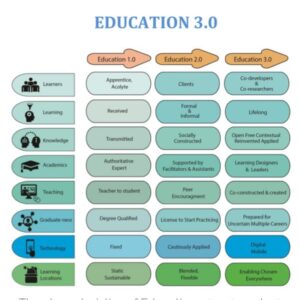
Gerstein (2014) wrote an article on comparing the development of the Web to Education. With the evolution of the internet, it is logical that schools worldwide have been following suit in the utilization of the internet in order to further educate the students. Nowadays, online classes use Zoom, Microsoft Teams, or Google Classroom. Some teachers use interactive sites like Padlet and Kahoot to make the students more engaged. Gerstein further explained about Education 3.0, that it is affording us with relevant, interactive, and networked content that is freely and readily available and personalized (based on individual interests). It is very similar to Web 3.0, wherein it provides users with richer experiences — it tailors the internet browsing experience to each individual.
With Web 3.0, educational institutions will be able to tailor the learning experiences in a more personalized manner for the students. Learning may be more individualized, and more advance tools will be used to teaching and learning, beyond just researching on the internet. In Education 3.0, Gerstein furthered that learners will be more engaged as connectors, creators, and constructivists. Learning will be more like a “web of networks,” with learners as content producers and sharers, using social networks for connecting, and using the web as curricula.
With the shift to Web 3.0, however, even though it is ideal for more advanced learning, there will most likely be students and teachers, including educational institutions, that will be lagging. This is in terms of internet connectivity and software availability — definitely, the cost of these can be a hindrance for some or even most of the stakeholders, especially students.
Conclusion
The development of the web and education can be said to be intertwined. As the internet develops, so does education — the educational sector uses web-based tools nowadays in this modern era. Desktops, laptops, and even tablets sometimes are generally essential for the students and teachers. I cannot imagine teachers nowadays who do not need computers for their instruction or students who do not use computers. However, the rapid development of the internet may not catch up in terms of education with all in the education sector. Thus, governments must aid the development of both the internet vis-a-vis the educational sector, in order that no one will be left behind in terms of learning.
I have watched The Social Dilemma a few times now but each time I do, I get as equally freaked out. On the surface, the social web has influenced society in a few positive ways such as connecting people from across the world, and allowing family members to keep up with each other's lives easier.... Continue Reading →
The rapid development of the internet has completely transformed the way we share information and knowledge. We went from the static Web 1.0 sites to the highly interactive Web 2.0 platforms, and now we are stepping into the new era of Web 3.0. Let’s explore which opportunities and challenges each stage of this digital evolution has presented for learners and educators.
The Development of the Web and Its Impact on Education
While reading Nupur Choudhury’s (2014) article World Wide Web and Its Journey from Web 1.0 to Web 4.0, I could totally trace the parallels with Jackie Gerstein’s (2014) idea that the development of the web can be a metaphor of the evolution of education. According to Choudhury (2014), Web 1.0did not provide enough opportunity for users to interact with each other and with websites. The passive nature of Web 1.0 reminds me of the education model that existed before the constructivist approaches gained popularity. Instructors used to be the “carriers” and “deliverers” of knowledge, and students were mostly passively absorbing and memorizing information. As Raul and Stacey mentioned in their fascinating presentation, Web 1.0 would rather support the cognitivetheory – learning is internal and is a result of people processing received information. Moreover, before the invention and spread of devices that could record and/or play audio and video materials, learners had access exclusively to written or printed sources of information outside of classroom, such as books, journals, lecture notes, etc. Similarly, Choudhury (2014) considers “read only content” to be one of the characteristics of Web 1.0.
Web 2.0offered more interaction opportunities to the users – as Choudhury (2014) mentioned, it allowed “assembling and managing large global crowds with common interests.” Web 2.0 starts to remind me more of constructivism as it facilitates “collective knowledge production” (Choudhury, 2014). Web 2.0 enabled users to publish blog and social media posts, podcasts, wiki articles, etc. Thanks to Web 2.0, we, graduate students, are now exchanging our thoughts and insights in our WordPress blogs. As we also learned from Raul and Stacey’s presentation, Web 2.0 made online participation and content sharing more achievable, which supports such learning theories as social constructivism and connectivism.
The next stage of the evolution of the internet, Web 3.0 (or Semantic Web), makes it possible for users to find, exchange, and organize information more easily. It enables machines to comprehend and respond to complicated human requests, which presupposes that the relevant sources of information should be semantically structured (Choudhury, 2014). There is no doubt that the futuristic innovations of Web 3.0 have – and will continue to have – a tremendous influence on education. For instance, we can already witness various opinions on the role of AI in education, which range from excitement (and a growing number of AI tools specifically tailored for teachers and learners) to fear that students’ academic integrity and writing skills development can be significantly undermined.
Marina Theodotou (2023) is overall optimistic about the impact of Web 3.0, as she believes that with it “learners have greater autonomy, resources are easily accessible, and technology drives innovation in teaching and learning.” According to Theodotou (2023), Web 3.0 creates a user-controlled environment which understands and adapts to users’ needs and where content is verified based on particular criteria and data. The author also states that Web 3.0 is capable of personalizing learning experiences by analyzing your learning style, preferences, and previous activity and therefore customizing your learning journey for you. Virtual and Augmented Realities are able to provide learners with immersive experiences. Who wouldn’t want to attend a history class set in an actual ancient world viewed through the lenses of highly innovative VR glasses! Another advantage of Web 3.0 is that it makes information and multimedia more accessible for users, activating a more holistic comprehension of a topic (Theodotou, 2023). However, some may argue that more accessible information does not always mean more effective learning, as online sources are not always completely credible. That makes the role of critical thinking even more vital for modern learners, especially while working on creative or research assignments.
Shift to Web 3.0 – a Privilege or a Disadvantage?
Neil Postman (1988) claims that newly created technologies are always advantageous to some people and harmful to others. The same idea, in my opinion, applies to Web 3.0 (and all of the other Web versions) – some educators and learners will find the changes in the digital world useful, while some might not.
As a teacher who constantly uses the internet to prepare and deliver lessons, I can definitely see a lot of ways in which educators can benefit from Web 2.0 and 3.0. I love having a perpetual access to enormous ever-updating database of materials that teachers constantly share with each other. I even utilized some social media posts and videos as educational resources to make my class more modern and engaging. Another asset of Web 2.0 I have tried out is blogging – I used to run a small YouTube channel and an Instagram account related to learning English. It was an amazing teaching experience that connected me with numerous ESL teachers and learners, and I still keep in touch with some of them. Ashley Collar and Edgar Klusener (2018) believe that one tweet can start a whole social movement – so who knows, maybe my little blogs also helped at least one or two users improve their English!
As for the shift to Web 3.0, I am also doing my best to explore its new possibilities in my teaching practice. For example, I am trying to incorporate AI in my lesson planning process. I have been using Twee AI to generate questions to texts and YouTube videos. I have also asked ChatGPT to create several listening transcripts for my students, which I then recorded. Alternatively, even recording is not a necessity anymore, as such AI tool as Roshi can voice a pre-prepared text for you! In October, I attended a conference organized by Alberta Teachers of English as a Second Language (ATESL), and it included several presentations that discussed the benefits of teachers using the AI technology. AI can save teachers a lot of time and energy and provide the them with some fresh ideas.
As for learners, they will definitely benefit from multiple features of Web 3.0, such as personalization of the online environment or summarizing large pieces of information. Furthermore, tools like Grammarly or ChatGPT will be able to check students’ grammar and punctuation and even provide clarification of their mistakes. It will considerably increase learners’ capacity to be the “owners” of their learning and to practise outside of class when the teacher is not there to support or explain.
However, sometimes it seems like technology is moving too fast. I am 24 years old, but I still occasionally feel “old” when I deal with some of the modern devices or innovations. For many people, the evolution from Web 1.0 to 3.0 happened during their lifetime, and it is just too overwhelming to learn how to navigate new changes at such pace. Consequently, teachers and learners with the lack of technical skills may often feel left behind and disadvantaged.
Another complication that the new web may cause is related to affordabilityof the newly introduced programs and devices. We have discussed the pros of VR and AR technologies and their educational implementation, but it is important to admit that it is currently financially impossible to popularize their use in public education due to the cost of the devices used for these technologies. As a result, new learning and teaching opportunities may not be equally accessible to everyone.
To sum up, the internet has already become an inseparable part of our lives, and it is being adjusted and modernized faster than we can imagine. As educators, we should try to keep up with all of the changes the web is going through while bearing in mind its potential positive and harmful effects on learning. However intimidating the new stage of web can be, we should try to view it from Jackie Gerstein’s (2014) perspective – as a wonderful database of tools, resources, and information.
Today’s presentation has given me a new perspective about Education 3.0. The transformation of Education from 1.0 to 3.0 sheds light on the learner-driven concept where students are allowed to set their own learning objectives and become self-determined. Jackie Gerstein has compared the evolution of the Web from 1.0 to 3.0 with the drastic revolution of education from 1.0 to 3.0. This metaphor captures the whole new version of education- 3.0 which emphasised on various skills like critical thinking, creativity, 21 century skills and highly personalised and child centered learning environment. If we think about what an Education 3.0 classroom looks like, imagine a room in which students might have the full right to choose and pursue self-directed learning path. This approach not only emphasises critical thinking and creativity but also help the educators to meet the diverse needs of the students in the real world.
The radical shift of the Web from 1.0 to 3.0 in education have both positive and difficult implications. This shift have not only focused on personalized learning through various flexible learning platforms that involve AI but also making sure that the course material is relevant and easily accessible to meet the diverse needs of individuals. Thus, I believe this drastic change have brought easy access to open and global knowledge, allowing students from different environments to connect with diverse resources and communities.
However, I think there are some disparities such as those students who have easy access to latest technologies and digital literacy will thrive, while those who lack these resources, they may have to face various limitations in educational engagement and access to comprehension . For example, especially rural and underserved communities, may suffer shortcomings in a 3.0 educational setting without sufficient digital infrastructure and skills training.
The teachers who will be privileged by this change are those who are technology freaks and proficient in using digital tools. Just like me, I love using advanced digital tools to design and manage my work and make my learning better. We can enhance the educational experience by integrating technology, also fostering more engaging and creative learning environments for our kids. The students who will get disadvantage from the advancement of Education 3.0 are those who belong to marginalised groups as they have limited access to the technology yet the educators are advocating for the policies and infrastructure that promotes inclusivity and educational equity in the education 3.0 model and benefits everyone equally.
The presentation on how Web 1.0 evolved to now Web 2.0 is a fascinating topic. In the Educational Researcher, 2009 it was stated by Christine Greenhow that “Web2.0 technologies offer unprecedented opportunities for students to create, share and collaborate in ways that were not possible with Web 1.0.” Imagine now in 2024 what students can do on the web compared to the past. Web 1.0 was really a place where people could access information, but the interaction and collaboration was lacking for that reason on an educational pedagogical level was really supported a cognitivism learning approach. The theory in cognitivism is firmly based on the notion that information/knowledge acquisition is an active learning process. How I see this is that the person in the Web 1.0 era would “actively” seek out information on the web.
Subsequently, Web 2.0 has vastly changed the landscape pertaining to pedagogy in education. What shifted was the ability for people to now become more interactive and collaborative. You can see that connectivism and social constructivism learning theories becoming more prominent. In the history of learning pedagogy connectivism is one of the new kids on the block. Stephen Downes mentioned that “knowledge has many authors, knowledge has many facets, it looks different to each person, and it changes moment to moment. A piece of knowledge isn’t a description of something, it is a way of relating to something.”. This statement for me would present a position that people can learn optimally only when they can bring personal general information, other viewpoints, and perspectives and through an environment of collaboration. When these components are in place then and only then can make sense of the information and therefor be able to solve or at least make a conclusion on the presenting issue that is before them. Because of the ever-evolving technological field due to advancements. You can see a correlational relationship between increased collaboration in sharing of information with other people and the advanced of technology.
Social Constructivism is a little different for the learning theory believes that learning takes part primarily in social and cultural settings, instead of learning in isolation. This comment is supported by Schreiber and Valle, 2013 comment in the article from Science Direct (2017). One aspect I find fascinating is when Vygotsky’s theory of social constructivism refers to the zone of proximal development. This points out that a teacher can have profound influence on a person’s learning. I remember years ago an article that I read that stated that when working with students with profound challenges actually can be hindered by the proximity of the educational assistant or teacher. In essence if the student is not permitted to learn and practice the skills taught to them due to an EA or Teacher doing it for them, then you will find a dependency will occur. What happens is in that sense you can hinder learning. However, now with technology you can have students now master learning skills and being able to connect with the teacher when needed. That physical proximity is not present and thus hopefully people will take on a more active learning in their personal development.
In closing with Web 3.0 coming closer every day and the introduction of Generative AI. You see how connectivism and constructivism learning theory is more important today then ever before. I would assert that Web 3.0 will bring upon a level of interactivity that back in 2009 anyone would have seen coming.
This week’s presentation was eye-opening on the emergence of Web 1.0 and Web 2.0 and how these World Wide Web versions have significantly transformed our virtual interaction process. In the presentation, Raul described Web 1.0 as a “static web or read-only web characterized by its simplicity, limited interactivity, tendency of static content and one mode of transmission ”. In Web 1.0, teachers could transfer educational content to the learner by using easy-to-access, visualized techniques where learners are passive recipients of knowledge, and all they do is listen to the teacher, take notes and respond to assessments verbatim as the teacher taught them (Gerstein, 2014). Learning was teacher-centred, and dissemination of knowledge was one-directional.
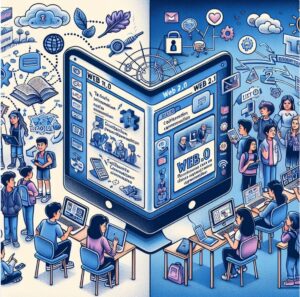
Further in the presentation, Stacey explained the transformation of Web 1.0 to 2.0 as introducing more collaborative websites and applications and generating content-sharing platforms like Wikipedia, blogs, and social media, which have become a part of most people’s lives. This technology was characterized by its increased bandwidth, better online browsers, online data storage, cloud computing, etc. The transformation of the interactive nature of Web 2.0 tools can also be likened to how relationships between students and teachers are being established in Education 2.0. According to Gerstein, this transformation has brought about the use of innovative pedagogical strategies like project-based learning, inquiry-based learning, and cooperative learning with the use of collaborative and interactive platforms. Teachers are considered facilitators of knowledge in this context, even if they still remain the custodians of knowledge. Unfortunately, some teachers are still struggling to implement these innovative pedagogies in their classroom practices. The use of Web 2.0 tools gives learners the opportunity to become contributors of knowledge, have opinions on educational dialogues, be active in their learning, and get the opportunity to collaborate and share ideas.
Differences Between Web 1.0, 2.0 and 3.0 Image via geeksforgeeks
Looking at the emergence of advanced learning technologies and their features, one can say that there is an ongoing transition from Web 2.0 to 3.0. This is characterized by the ability to combine and integrate web content and services into existing Web 2.0 platforms with the aim of improving the end-user experience. This transition can be seen in how open resources are being used in online learning platforms. According to Gerstein (2014), Education 3.0 reimagines learning as a participatory and networked process, emphasizing the integration of technology and student-driven learning with the aim of promoting inclusive learning and cultivating a culture of lifelong and learner-centric knowledge production, which can help foster human-capital development. The transformative impact of Web 3.0 on education, as indicated by Garstein (2014), is characterized by its personalized, participatory, and interactive nature. With Web 3.0, education becomes highly adaptive, as technologies such as artificial intelligence and the Semantic Web enable tailored learning experiences that meet individual student needs.
According to Gerstein, this environment privileges students who are digitally literate, self-directed, and comfortable with autonomous learning processes, as Web 3.0 emphasizes student agency and resourcefulness. However, this shift also raises concerns about accessibility and equity. Students and teachers who lack technological fluency or reliable access to digital resources may find themselves at a disadvantage, potentially widening the digital divide.Several studies have shown that Web 3.0’s tools can serve as personal learning assistants, which is beneficial for learners who can actively navigate and leverage these technologies. However, those that are less familiar with digital platforms may struggle. I think it is crucial to approach Web 3.0 resources with discernment and critical engagement, especially for students and teachers that lack media literacy skills, to mitigate potential drawbacks. As Stacey indicated, because of Web 2.0 and 3.0, developing the digital literacy skills of students is very crucial .
I am grateful to presenters for today’s talk because they unfolded a new mystery for me as I was completely unfamiliar with the terms Web 1.0 and Web 2.0 and I never knew these terms before. As discussion proceeded, I got familiar with these things. And I was also introduced with the implications of Web 3.0, if initiated, during this class session. With the gathered information, I am much excited to write a blog on impact of introduction of Web 3.0 on education.
“The web influences people’s way of thinking, doing and being, and people influence the development and content of the web. The evolution of the web from Web 1.0 to Web 2.0 and now to Web 3.0 can be used as a metaphor of how education should also be evolving, as a movement from Education 1.0 toward that of Education 3.0. The Web, Internet, Social Media, and the evolving, emerging technologies have created a perfect storm or convergence of resources, tools, open and free information access.” (Jackie Gerstein)
I believe, undoubtedly, technology or internet is progressing at fast pace and addition of features is made possible in upcoming years. Internet Web 1.0 transformed to Web 2.0 and now at the verge of Web 3.0 which transformed the education from 1.0 to 3.0. New technological tools generated with the help of Web 2.0 added new web tools in classrooms for teaching and learning. As an educator, I prefer selecting these digital tools to make teaching more effective and dynamic.
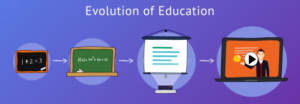
Gerstein metaphor: Transformation of Education
The evolution of internet from Web 1.0 to Web 2.0 and now Web 3.0 has made a huge impact in transformation of education from Education 1.0 to education 3.0, ultimately that has helped in understanding the shifting of nature of teaching and learning. Gerstein metaphor helps in following changing landscape of education. It has constructed education landscape in a positive way as it has shifted teaching learning towards student centric wholly.
Education 1.0 was uni-directional, in which students were at receiver’s end and instructivism approach having very sources like teachers, libraries, classnotes, handouts and World Wide Web in latest were used. This shifted towards, Education 2.0 in late 2000, in which teaching was interactive, focused on constructivist approach, developed with the emergence of social-media, Wikipedia and blogging. It involves more participation and content sharing. Updated most Education 3.0 in which social networking and social benefits play significant role in teaching and learning. Connectivist approach is practiced.
Implementation of Web 3.0 will be advantageous as it will help to eradicate digital divide from our society as it will make digital resources readily available to large proportion of populace. Additionally, it will make wholly student centric learning and more effective.
Although it has many more advantages of shifting towards Web 3.0, such as bringing equity in education and eradicate digital divide, yet it will not be able to benefit certain group of people, known as disadvantaged group while the other is called advantaged group. It helped to raise certain Social movements, such as Black life matters.
young-man-patiently-guiding-an-older-man-in-using-a-smartphone-set-in-a-minimalist-interior-with-light-colors-symbolizing-the-harmonious-bridge-between-generations-through-technology-stockpack-adobe-stock.jpgPrivileged or advantaged Group: It is going to provide facilitation to the people
I currently teach in a face-to-face setting. However, the Covid-19 pandemic provided me the opportunity to expand my horizons in terms of online/distance delivery. I have become very confident using Google’s productivity suite. The school division I currently work in had not yet made the switch to Edsby at this time, meaning Google Classroom made the most sense to organize and present material to students. It provided a space to connect with students, organize hand-in assignments, and even distribute group work. Google Docs allowed students the opportunity to work together on an assignment in real time. It was also very efficient once students had completed the assignment, giving them a space to hand in their work directly through Google Classroom.
I believe that the format of distance learning has changed drastically over the last little while. When I was in high school, it was often students reading an online version of the textbook and answering questions on a printed document that would then be scanned and returned to the distance learning teacher. Today, online learning provides three major advantages according to Jingshu Gu: teachers and students can interact in real time using conferencing apps, the material often includes many forms of media that make learning interesting, and personalized learning guidance can be provided. Although, online learning opens more doors for students, especially when it comes to classes that are not offered within their schools, online learning is not for everyone. I have witnessed many students fail online classes and their number one reason for not passing the class is the lack of relations with their classmates, as well as their teacher. There is something about learning from someone in the same room as you that I do not think online learning will ever be able to match.
In conclusion, many of the classes that I currently teach face-to-face would be an easy conversion to an online format. I enjoy using technology within my classroom, providing students the opportunity to complete their work using productivity suites as well as the internet for guided research. I believe that teaching students how to comb through information and compare information from different websites is very important, as they grow into young adults. However, there are some classes such as Physical Education that are best left to in-person learning. I cannot imagine a world where students are never exposed to working together as a team face-to-face, learning how to deal with conflict that often arises during group activities, and strategizing with other people.
Hey there! Today, we will go into the exciting world of learning theories and see how they shape digital and collaborative learning. After the class on digital and collaborative learning, and after listening to Dr. David Parsons, https://youtu.be/fEC2fLcz7Rk?si=r7vloADak6KH-RTc he shared some great insights on ten key theories that help us understand how people learn in today’s technology-filled classrooms. But while these theories are important, it’s also more important to think about the tools we use and how they connect with students. Let’s break it down!
First up is conditioning, thanks to thinkers like Pavlov and Skinner. They showed us how rewards can help people learn. Think about how many learning apps give you badges or points when you do well. While that’s fun, we have to ask: Are we just training students to hit buttons, or are we helping them become real thinkers? It’s all about balance, reinforcement should help, but it shouldn’t replace deeper understanding.
Next, we have Vygotsky and his idea of social learning. He believed learning happens best when we work with others. In digital spaces, tools like group chats and collaborative documents can help students work together effectively. But we need to make sure those online interactions are meaningful and constructive engagements. Just because students are chatting online doesn’t mean they’re truly engaging constructively with each other.
Then there’s situated learning, which is all about real-world practice. Think of it like learning how to cook by actually cooking, not just reading a recipe! Online tools can help students practice skills in realistic situations, but we need to ensure these experiences are real. In addition, creating a friendly online community where students feel safe to share their experiences is very essential for effective learning together.
Last but not least, I reflected on connectivism, introduced by Siemens. This theory tells us that in today’s world, learning happens across networks and connections. With so much information online, how do we help students sort through it all? It’s vital to teach them how to evaluate sources and think critically. Technology should empower students to navigate the info overload, not just be a flashy tool for quick facts, or what do you think?
Dr. Parsons’ exploration of these learning theories gives us lots to think about as we teach in a digital world. But remember, just using new tech isn’t enough. We need to blend these theories with the right tools to create a fun and engaging learning environment.
In the end, it’s all about the relationship between technology and students. Let’s make sure we’re fostering not just knowledge, but also creativity and collaboration. After all, in this fast-paced world, we want our students to be not just good learners but also great innovative thinkers!







 Further in the presentation, Stacey explained the transformation of Web 1.0 to 2.0 as introducing more collaborative websites and applications and generating content-sharing platforms like Wikipedia, blogs, and social media, which have become a part of most people’s lives. This technology was characterized by its increased bandwidth, better online browsers, online data storage, cloud computing, etc. The transformation of the interactive nature of Web 2.0 tools can also be likened to how relationships between students and teachers are being established in Education 2.0. According to Gerstein, this transformation has brought about the use of innovative pedagogical strategies like project-based learning, inquiry-based learning, and cooperative learning with the use of collaborative and interactive platforms. Teachers are considered facilitators of knowledge in this context, even if they still remain the custodians of knowledge. Unfortunately, some teachers are still struggling to implement these innovative pedagogies in their classroom practices. The use of Web 2.0 tools gives learners the opportunity to become contributors of knowledge, have opinions on educational dialogues, be active in their learning, and get the opportunity to collaborate and share ideas.