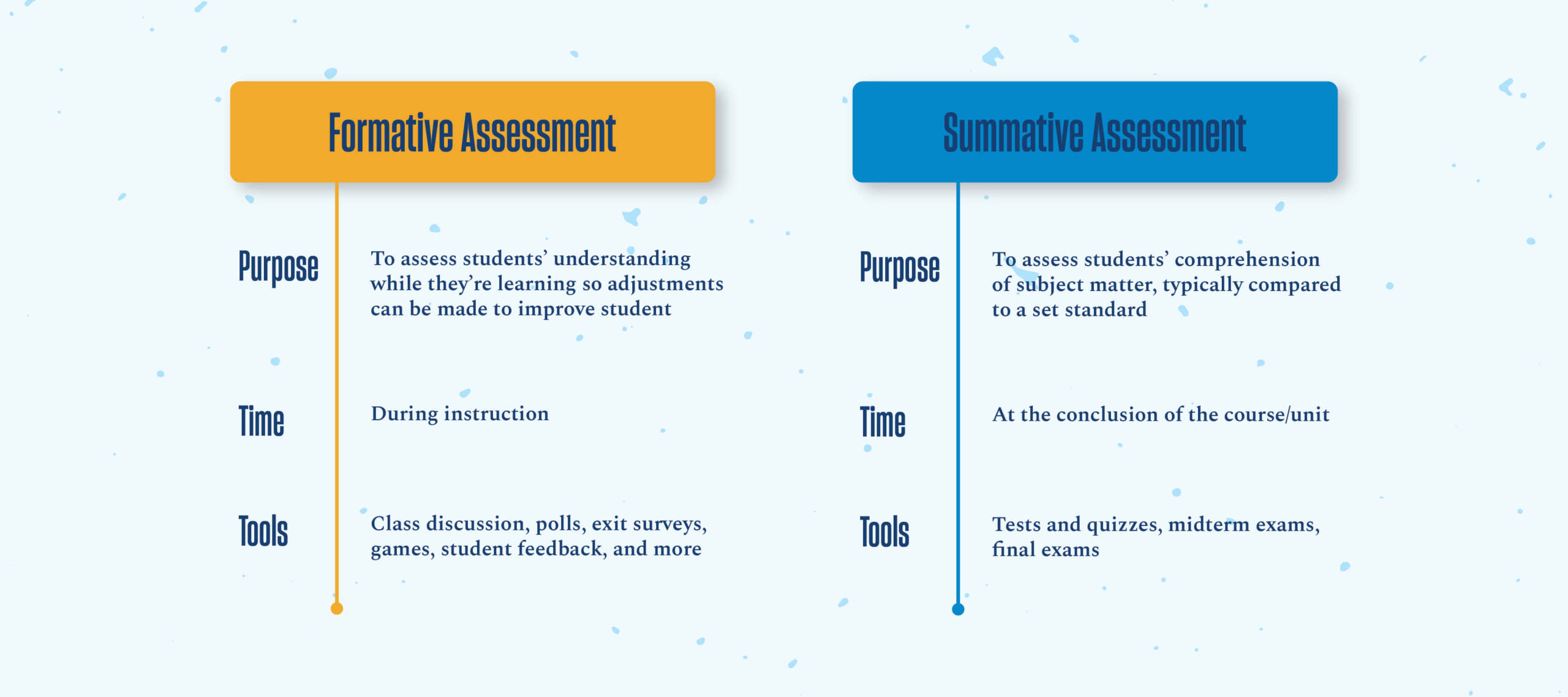
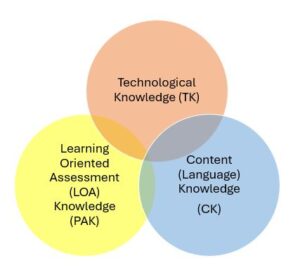
All of us, educators, know the feeling of seeing a pile of ungraded assessment tasks on our desks – an unmistakable indicator of several subsequent hours of work. That is probably the reason why so many teachers are experimenting with online assessment forms nowadays as they seem to save us a lot of time and effort. As Eddy, Latoya, and Nysa mentioned in their wonderful presentation, digital tools enable more frequent assessment, faster feedback, and easier data collection for future analysis (the latter point is also described in detail in Matthew Cullen’s article). At the same time, however modern and advanced digital assessment may seem, it may sometimes be a step back from the newly developed efficient testing practices.
Examples of Digital Assessments From My ESL Classroom Experience
I don’t practise a lot of online-based assessments with my students as I teach adult newcomers from a wide range of educational, professional, and age backgrounds, and the levels of each student’s computer skills vary a lot. Therefore, introducing too many digitalized tests may add unnecessary stress for some students. However, we still do quite a few online activities in class, so here are some ideas I have personally implemented:
| FORMAL ASSESSMENTS/SKILL-USING TASKS |
INFORMAL ASSESSMENTS/ACTIVITIES |
| Using an online dictionary
The students had to copy a definition of a certain word/phrase from 1-3 online dictionaries that I had introduced them to.
As a result, the learners:
· practised their computer skills (multiple-step searching);
· got to know several widely used dictionaries (it’s useful to have a better alternative to Google Translate!);
· practised their copying and spelling skills. |
Ellii and Raz-Kids
If you happened to read some of my previous blog posts, you must be tired of me mentioning Ellii and Raz-Kids  Nevertheless, these website are totally worth being mentioned over and over! They offer numerous interactive lessons (Ellii) and books (Raz-Kids) on different topics, and they foster my students’ independence by providing them with immediate feedback and suggestions for improvement. Nevertheless, these website are totally worth being mentioned over and over! They offer numerous interactive lessons (Ellii) and books (Raz-Kids) on different topics, and they foster my students’ independence by providing them with immediate feedback and suggestions for improvement.
However, I do not use Ellii and RazKids in class more than 1 or 2 times a week as they mostly support behaviourism – the learners are motivated by the programs’ positive responses rather than by multi-sided self- and peer evaluation. Eddy, Latoya, and Nysa called such responses “external reward”, which means that it does not always reflect students’ actual growth process. |
| Searching for a program on Regina Public Library website
The students had to follow instructions to find a certain program on the library website. I was observing each student individually.
As a result, the learners:
· practised their computer skills (searching, navigating a website);
· learned about multiple library programs they and their families can attend in real life |
What Can We Do to Ensure That Online Tools Support Effective Assessment Practices?
- Remember that technology is just one of the tools, while your students’ learning is the priority
As you probably noticed, both of my computer-based assessments described in the left column of the table are real-world tasks and could be easily applied in everyday life. This is one of the main requirements of Portfolio-Based Language Assessment (PBLA) – a teaching model used in Language Instructions for Newcomers to Canada (LINC). I believe that this principle – making assessment as close to the reality as possible – is the key toward supporting beneficial testing practices. No matter whether we evaluate our students’ skills on paper, through a conversation, or online, we shouldn’t forget that the goal of our teaching is to prepare our students for the real world. Prioritizing our learners’ success will naturally guide us to choosing the right style of assessment, and its format (be it digital or traditional) will just remain a tool to execute that assessment.
- Alternate between different types of assessment
Using online tools can increase learners’ engagement and even make our tests less stressful and more interesting for our students. Nonetheless, just as traditional assessments face a risk of becoming too repetitive and even ineffective, so do online ones. The key to avoid that is to implement different kinds of assessment in your class. I believe that alternating between online, paper-based, and conversational activities will give students an opportunity to demonstrate their skills in various ways and help us as educators compare different testing approaches.
- Give personalized feedback
Even if the computer has promptly graded your students’ multiple choice assignment, it still does not mean that they will benefit from just finding out their scores. As instructors, we should do our best to give learners personalized feedback that would help them understand why they made certain mistakes and what they can do to improve. It is certainly complicated to provide thorough comments to a large number of students, but we should at least try to follow up with the learners who need more support or who show a significant shift (whether a positive or a negative one) in their progress. According to Eddy, Latoya, and Nysa, digital tools are unable to appraise complex learning outcomes and do not allow users to engage thoroughly with their tasks. Though technology can greatly assist us in assessment, it can’t replace the value of individualized feedback.
Does Digital Assessment Have a Positive or a Negative Impact on the Society and Culture?
I suppose all of the technologies we have been discussing during these months are double-edge swords. Let’s stay optimistic and first look at the positive influence digital learning has on people’s lives.
According to UNESCO’s Technology in education – 2023 GEM Report, technology is making education (and, consequently, assessment) more accessible to hard-to-reach learners. Mobile devises have been utilized in remote areas to facilitate communication between instructors, students, and parents, especially during the COVID-19 pandemic. Open universities give disadvantaged and working adults an opportunity for life-long learning. Radio instruction, television, printed and audiovisual materials have been used to help reach their educational goals (UNESCO Technology in education – 2023 GEM Report).
Unfortunately, as we learned from Eddy, Latoya, and Nysa’s presentation and from the UNESCO report, online learning and assessment tools are still unattainable for many people as implementing them requires a certain level of digital literacy and access to electronic devices. Therefore, teachers and students who do not meet those requirements may feel substantially disadvantaged compared to others, even though the former might have more expertise and knowledge in other areas of learning. This might cause an unfair division in the society, separating “tech-savvy” educators and learners from the ones who are not digitally literate enough. In my opinion, there are several solutions to this issue:
One of the most world-popular English language assessments, IELTS, offers language learners several ways to take the test – online from home, in person on computer, and in person on paper. I feel that these choices perfectly accommodate all examinees. When I was taking IELTS Academic for my University of Regina application, I personally went for the second of the aforementioned options, and I was very satisfied with the process and the result of the assessment.
- Increasing digital literacy
It is certainly great that computer classes are now available at schools, but children and young people are not the only ones who are in need of good digital skills to achieve success. That is why computer literacy programs for adults could be of great help. The organization where I work as a LINC instructor provides such an opportunity to our clients, and several of my students have benefited from these digital literacy classes. The more people possess sufficient computer skills, the easier it will be to incorporate digital assessment into the education system without making anyone feel excluded.
- Introducing the changes slowly and gradually
It might be too much of a stress for students and educators to rapidly switch to digital assessment, so it would be a good idea to launch it carefully. Matthew Cullen proposes running “pilot online examinations for one department or faculty” and “assess the experience before making any major changes” (Matthew Cullen). The author believes this can ensure that a certain software would work well for a specific institution. Matthew Cullen also offers to survey all of the concerned parties as a part of the pilot study to evaluate how they feel about the potential digital changes.
With more and more technologies emerging every day, we can’t expect them not to influence the way knowledge and skills are assessed. Though digital educational tools are gaining a lot of popularity nowadays, it is important that we use them to develop modern, student-friendly assessment practices and not to go back to some of the obsolete behaviourist approaches. Furthermore, if technology-based assessment is to be introduced, we must make sure learners and educators are given enough time to adjust and enough opportunity to express their opinion about the changes.